
EXAMPLE 1
Standard tuning
12-TET
100.00 cents / step
The familiar piano grid uses a step ratio of approximately 1.059463.
Explore equal divisions of the octave from 1-TET to 53-TET, hear each step and compare microtonal pitches with the familiar 12-tone grid.
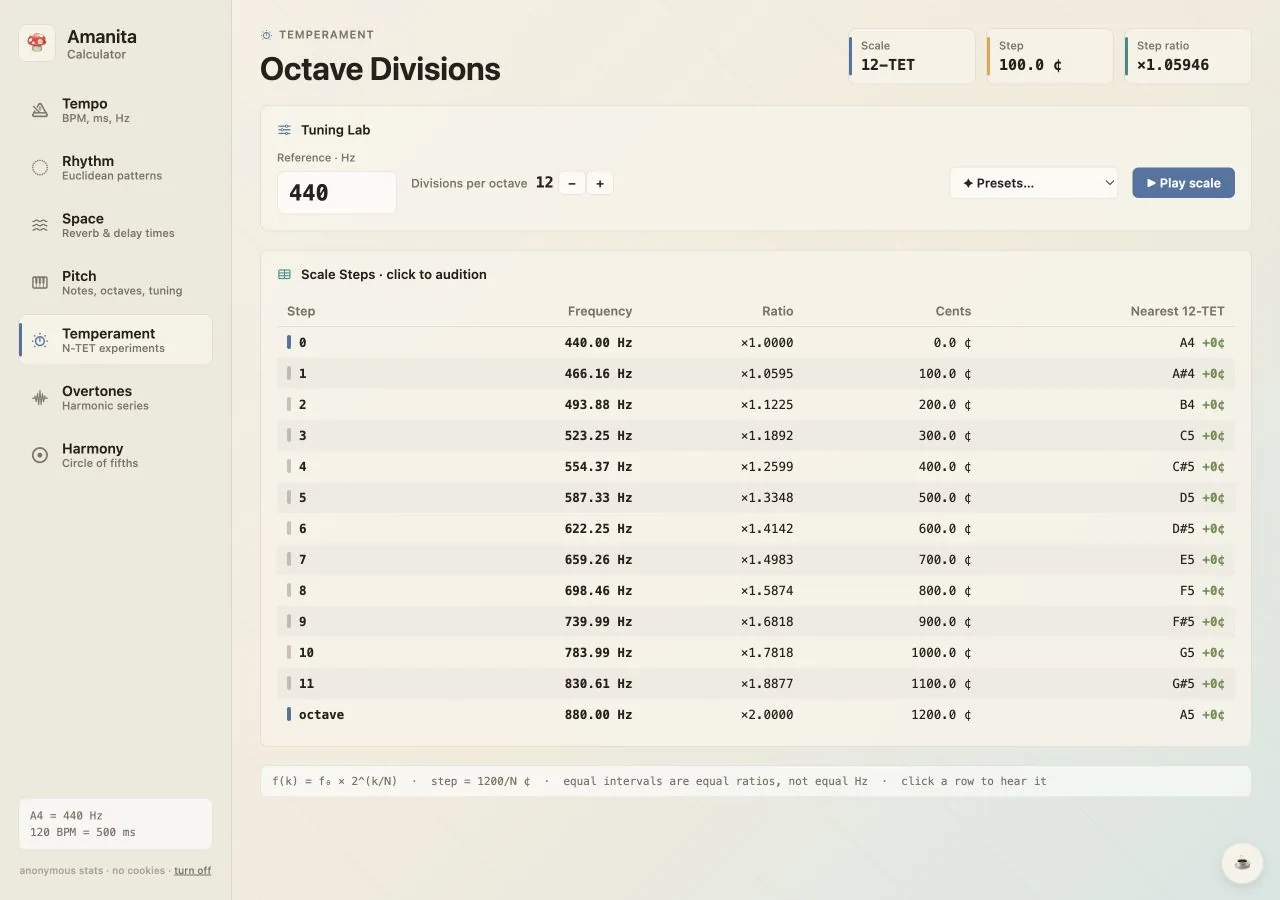
The final step k = N always reaches exactly one octave above the reference frequency.
N-TET means that the 2:1 octave is divided into N equal logarithmic steps. Each step has the same frequency ratio, while its size in cents is 1,200 divided by N.
Twelve-tone equal temperament is only one possibility. Nineteen divisions offer finer thirds, 24-TET provides quarter tones, and 31-TET closely approximates several just intervals. Amanita maps every step to its nearest 12-TET note and displays the cents difference.
Concrete values you can verify in the calculator and transfer directly to a production session.
The familiar piano grid uses a step ratio of approximately 1.059463.
Each conventional semitone is divided in half, creating 24 equal pitches per octave.
The seventh step is 442.11 cents above the reference and sits between familiar 12-TET notes.
| System | Step size | Frequency ratio | Typical interest |
|---|---|---|---|
| 9-TET | 133.33 cents | 1.080060 | Wide, unfamiliar scale steps |
| 12-TET | 100.00 cents | 1.059463 | Standard Western tuning |
| 19-TET | 63.16 cents | 1.037155 | Alternative thirds and diatonic scales |
| 24-TET | 50.00 cents | 1.029302 | Quarter tones |
| 31-TET | 38.71 cents | 1.022611 | Fine interval approximations |
| 53-TET | 22.64 cents | 1.013164 | High-resolution pitch lattice |
The calculator is deliberately direct: set the musical context, inspect the result and copy it where you need it.
Create scales that move outside the conventional twelve-note octave.
Calculate exact frequency ratios for oscillator or tuning-table programming.
Compare how different equal temperaments approximate familiar intervals.
Build evenly spaced resonator banks and spectral pitch structures.
Studio note: When comparing temperaments, listen to intervals as well as individual steps. The character of an N-TET system becomes clearer in chords and repeated melodic shapes.
Open the exact tool with your saved tempo and tuning values intact. Nothing to install, no account and no ads.