
EXAMPLE 1
Third partial
55 Hz × 3
165.00 Hz · E3 +2¢
The natural perfect fifth sits about two cents above its 12-TET counterpart.
Build the first sixteen partials above any fundamental, inspect their frequencies and see where natural harmonics diverge from equal-tempered notes.
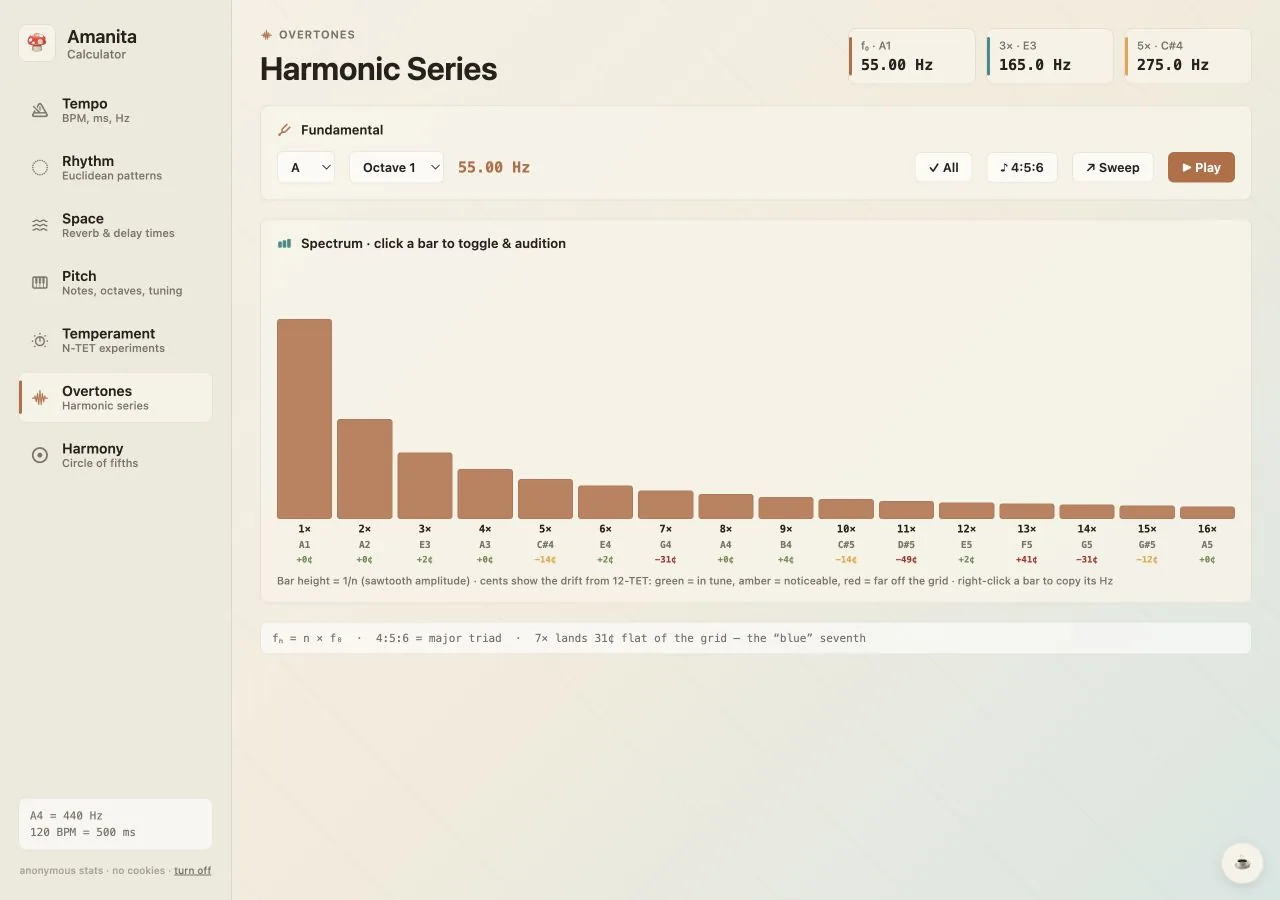
The amplitude rule describes the simple playback model in Amanita; real instruments emphasize and suppress partials according to their construction.
A harmonic series contains integer multiples of a fundamental frequency. If the fundamental is 55 Hz, its second partial is 110 Hz, the third is 165 Hz, and so on.
Octave harmonics align exactly with equal temperament, but many other partials do not. The fifth partial is close to a major third and the seventh is noticeably flatter than the equal-tempered minor seventh. Amanita shows that difference in cents and lets you hear it.
Concrete values you can verify in the calculator and transfer directly to a production session.
The natural perfect fifth sits about two cents above its 12-TET counterpart.
This natural major third is visibly and audibly flatter than the equal-tempered note.
The harmonic seventh falls far below the 12-TET minor seventh and has a distinctive color.
| Partial | Frequency | Nearest note | Offset |
|---|---|---|---|
| 1× | 55.00 Hz | A1 | 0.0 cents |
| 2× | 110.00 Hz | A2 | 0.0 cents |
| 3× | 165.00 Hz | E3 | +2.0 cents |
| 4× | 220.00 Hz | A3 | 0.0 cents |
| 5× | 275.00 Hz | C#4 | -13.7 cents |
| 6× | 330.00 Hz | E4 | +2.0 cents |
| 7× | 385.00 Hz | G4 | -31.2 cents |
| 8× | 440.00 Hz | A4 | 0.0 cents |
The calculator is deliberately direct: set the musical context, inspect the result and copy it where you need it.
Choose partials and understand the pitch structure behind a complex tone.
Predict harmonic regions above a bass note or resonant source.
Relate brightness and tone color to the strength of upper partials.
Compare natural harmonic intervals with their equal-tempered approximations.
Studio note: The first few partials contribute most strongly to perceived pitch and chord color. Start with 1× through 6× before adding the more dissonant upper harmonics.
Open the exact tool with your saved tempo and tuning values intact. Nothing to install, no account and no ads.