
EXAMPLE 1
Tresillo
E(3,8)
x..x..x.
Three accents across eight steps produce a familiar syncopated cell that works for kicks, bass and hand percussion.
Distribute a chosen number of hits as evenly as possible across a sequence, rotate the result and audition patterns before programming them in your DAW.
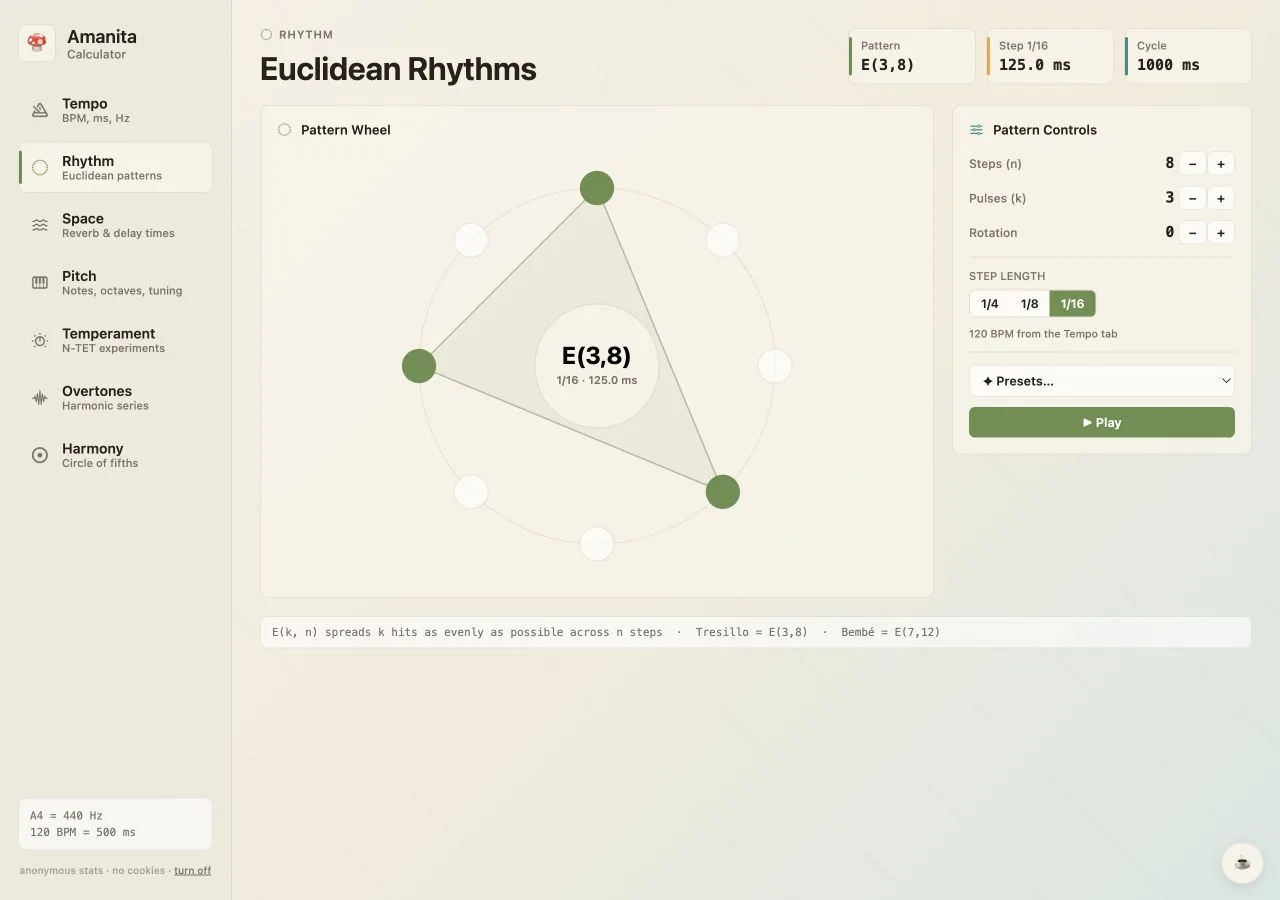
Amanita uses x for a hit and . for a rest. Different generators may display the same rhythm with a different rotation.
A Euclidean rhythm places k pulses across n steps with the most even spacing available. The notation E(k,n) means k hits distributed over n positions; rotation changes the starting point without changing the spacing structure.
These patterns appear naturally in many musical traditions and are useful for percussion, arpeggios, modulation and layered polymeters. Amanita lets you hear the result at the BPM shared with the Tempo tool.
Concrete values you can verify in the calculator and transfer directly to a production session.
Three accents across eight steps produce a familiar syncopated cell that works for kicks, bass and hand percussion.
A spacious five-hit pattern that can sit over a conventional four-beat loop without repeating too quickly.
Five hits create alternating gaps and a compact rhythm suited to hats, claps or melodic triggers.
| Pattern | Sequence | Density | Typical use |
|---|---|---|---|
| E(3,8) | x..x..x. | 37.5% | Tresillo / kick layer |
| E(4,9) | x..x.x.x. | 44.4% | Asymmetric percussion |
| E(5,16) | x...x..x..x..x.. | 31.3% | Sparse long cycle |
| E(7,12) | x.x.x.xx.x.x | 58.3% | Dense 12-step phrase |
The calculator is deliberately direct: set the musical context, inspect the result and copy it where you need it.
Build balanced kick, clap, rim and hand-percussion layers.
Place a 9- or 12-step pattern against a conventional 16-step loop.
Use hits as triggers for envelopes, samples or clocked modulation.
Rotate one pattern between sections while keeping its internal spacing.
Studio note: When layering patterns, leave different amounts of space in each one. Two dense Euclidean sequences can mask each other even when their mathematics is elegant.
Open the exact tool with your saved tempo and tuning values intact. Nothing to install, no account and no ads.